Concrete Repair vs Replacement: How to Make the Right Call
Cracks, pits, sunken spots.
You see them in your concrete, so you start rolling options around in your mind:
Which is the better choice—concrete repair or replacement?
You’re juggling safety, budgets, and disruption of your schedule. You don’t want to pour money into another “patch job” that fails. But you also don’t want to rip out concrete that could still be saved. It’s not an easy call, especially when you’re responsible for both people and property.
Keystone Gun-Krete has been working with concrete across south central Pennsylvania since 1980. We’ve seen slabs that just needed a smart repair, and we’ve seen others where replacement was the only honest recommendation. That experience helps property owners, contractors, and facility managers make long-term decisions they feel good about.
So, how do you know which way to go?
Let’s walk through the signs, costs, and lifespan differences so you can choose repair or replacement with confidence.






TL;DR - Concrete Repair vs Replacement
- Repair (through lifting and stabilization) is best for non-structural, settled slabs and localized issues.
- Replacement is better when concrete is broken, badly spalled, or structurally failing.
- Repair can add years of life when done right. New concrete lasts for decades when installed and maintained properly.
- Cost and disruption usually decide the tie: if repair only buys you a short time, replacement may be the smarter move.
Can This Concrete Be Repaired?
Before anyone talks about demolition or new concrete, a good contractor starts with one simple question:
“Is this slab still structurally sound?”
If the concrete is still solid—and the main problem is that it has settled or sunk—repair is usually on the table.
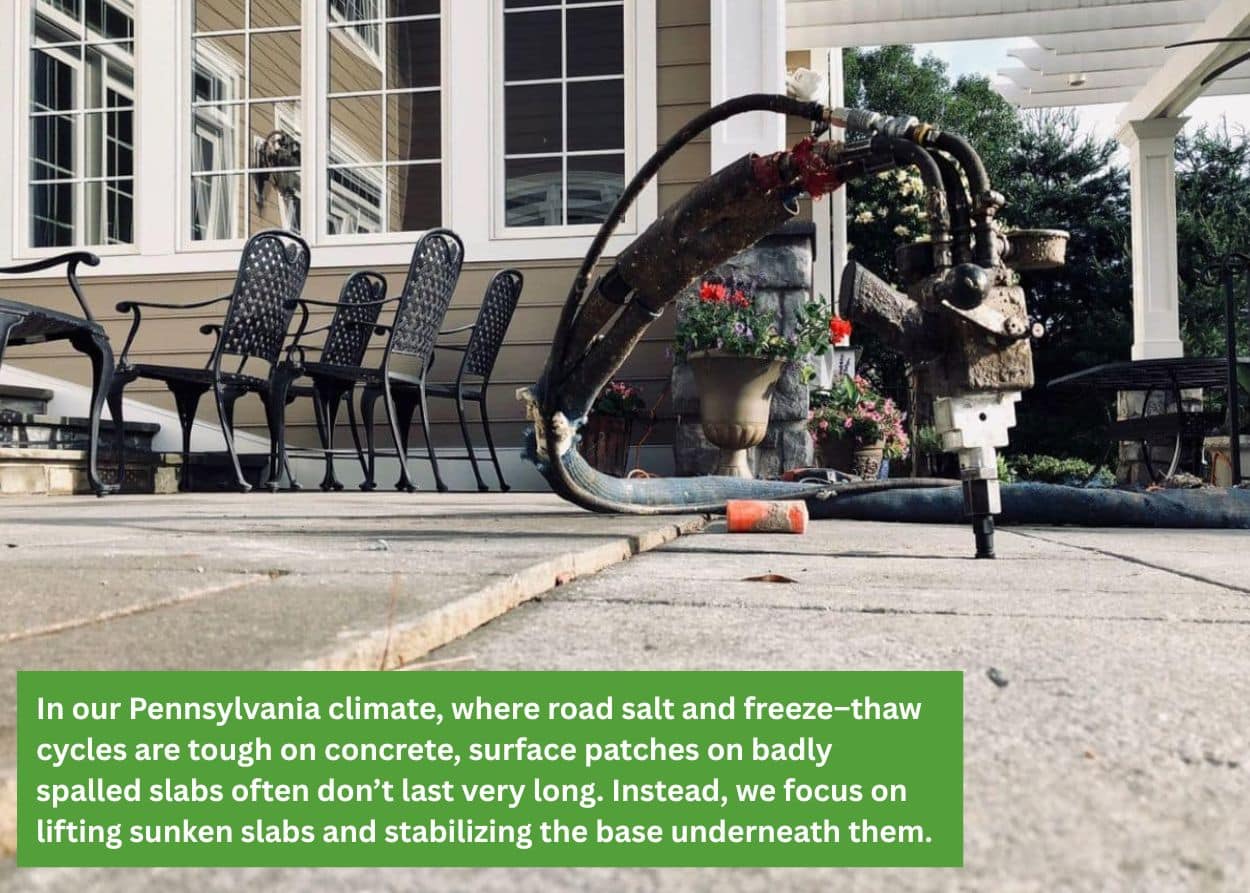
For Keystone Gun-Krete, “repair” doesn’t mean surface patching or cosmetic resurfacing. In our Pennsylvania climate, where road salt and freeze–thaw cycles are tough on concrete, surface patches on badly spalled slabs often don’t last very long. Instead, we focus on lifting sunken slabs and stabilizing the base underneath them.
Your concrete is often a good candidate for lifting and stabilization when:
- Panels have settled and created trip edges.
- Slabs have sunk but are not crumbled.
- There are voids under the slab.
- There are minor cracks and surface flaws.
In these cases, concrete lifting (also called slabjacking or concrete leveling) is a strong option. Keystone Gun-Krete drills small holes in the slab and injects a two-part polyurethane foam underneath. As the foam expands, it fills the voids, lifts the slab, and stabilizes the soil.
This lets you:
- Remove trip hazards
- Improve drainage
- Restore normal use of the area
- Get more years out of the concrete you already paid for
When the “bones” of the concrete are good, lifting and stabilization can restore function and safety without the cost and mess of full replacement.
When Replacement Is the Better Investment
Now, the flip side.
Sometimes, even the best lifting and stabilization can’t save a slab that’s simply too damaged.
When the concrete itself is breaking down, replacement is often more cost-effective than patching or propping up what’s already failing.
Replacement usually makes more sense when:
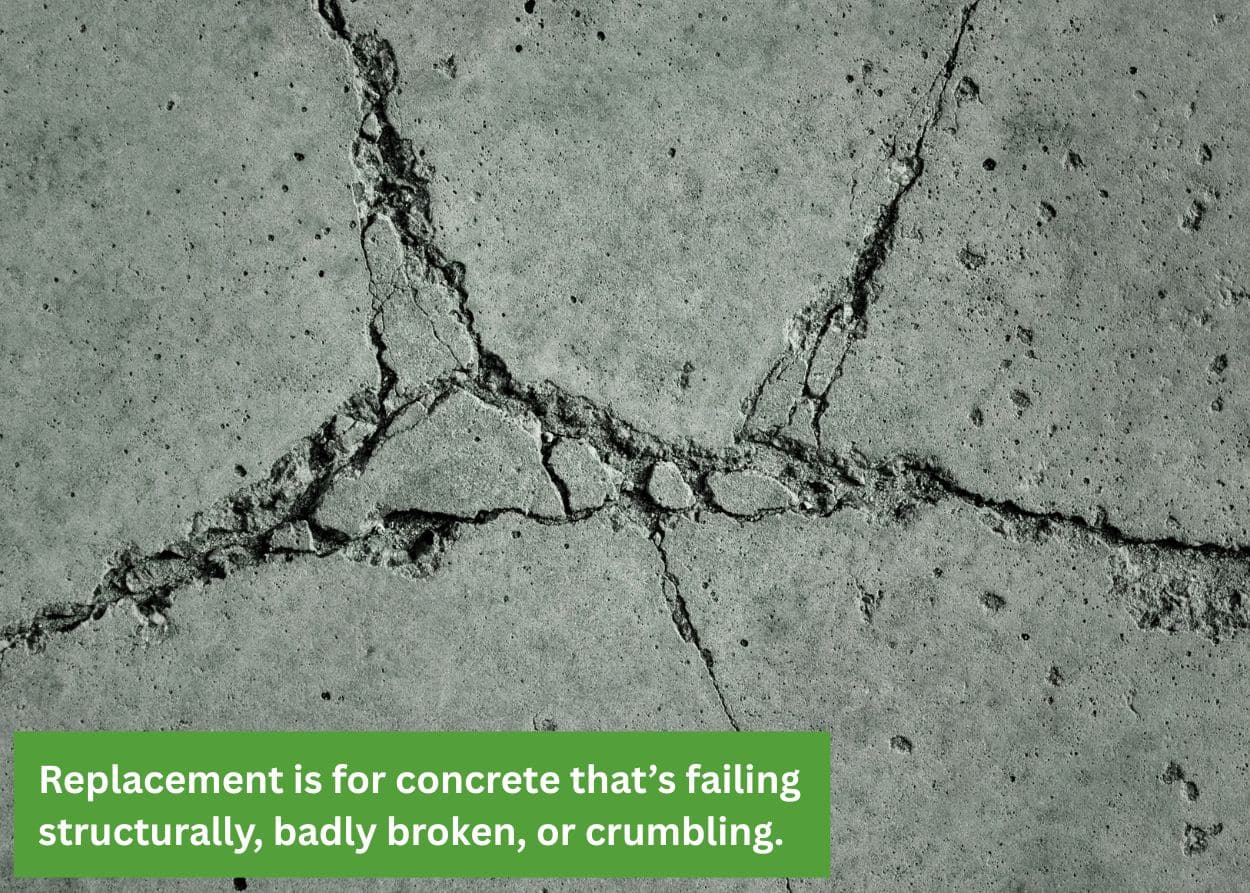
- Cracks are large and structural.
- Concrete is badly spalled or crumbling.
- Corners and chunks are missing.
- The slab has serious structural problems.
When concrete is failing from the inside out, new concrete often costs less over time than chasing short-term fixes. Replacement lets you start fresh with:
- A properly compacted base
- Correct slopes and drainage
- A concrete mix matched to your current loads and conditions
In short, repair is for good concrete that has settled.
Replacement is for concrete that’s failing structurally, badly broken, or crumbling.
Lifespan and Performance: Repaired vs New Concrete
How long will each option last?
Repair (Lifting and Stabilization)
Repair works best when the concrete itself is still solid.
For Keystone Gun-Krete, that means:
- Raising concrete back to where it should be
- Filling the voids that caused it to sink
- Stabilizing the soil so the slab has better support
- Sealing joints where it makes sense
When done right, a good slab can get many more years of safe use.
Replacement (New Concrete)
New concrete, poured on a solid, well-prepared base and maintained over time, can serve you well for decades. You’re starting from scratch with new concrete, a new base, and new drainage.
Cost and Disruption of Life or Business
Let’s be honest: cost and how much you can interrupt everyday life usually drive this decision.
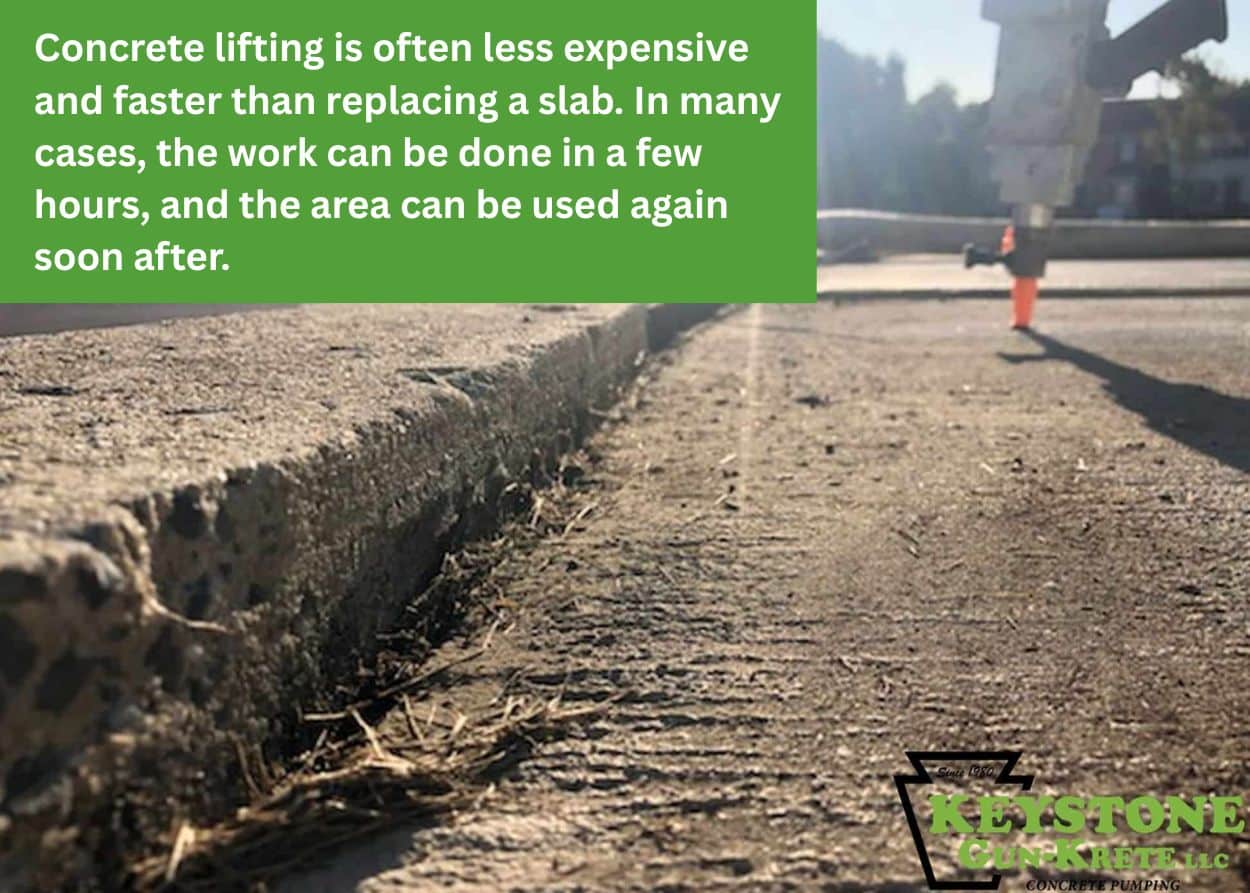
Concrete lifting is often less expensive and faster than replacing a slab. In many cases, the work can be done in a few hours, and the area can be used again soon after.
Repair often wins when:
- The problem is focused on certain slabs or joints.
- Your budget is tight this year, but the concrete still has life left in it.
- You can’t shut down key areas for long—like barns, warehouses, driveways, or walkways.
Replacement often wins when:
- You keep spending money on concrete that’s clearly breaking down.
- Safety and liability risks are increasing due to crumbling surfaces or broken edges.
- You need stronger, higher-performance concrete than you have now.
- The slab is so damaged that it can’t be lifted and supported as a single piece.
Yes, replacement costs more and takes longer.
But if the slab is failing across the board, the total cost of replacement over the long haul is usually lower than paying for one quick fix after another.
A simple rule of thumb:
- If lifting can safely give you several more years of solid use, it’s worth serious consideration.
- If it can’t be done safely—or would only buy you a short-time—replacement is probably the better long-term investment.
How Professionals Decide: What to Expect from an Evaluation
So what happens when you bring in a concrete specialist like Keystone Gun-Krete?
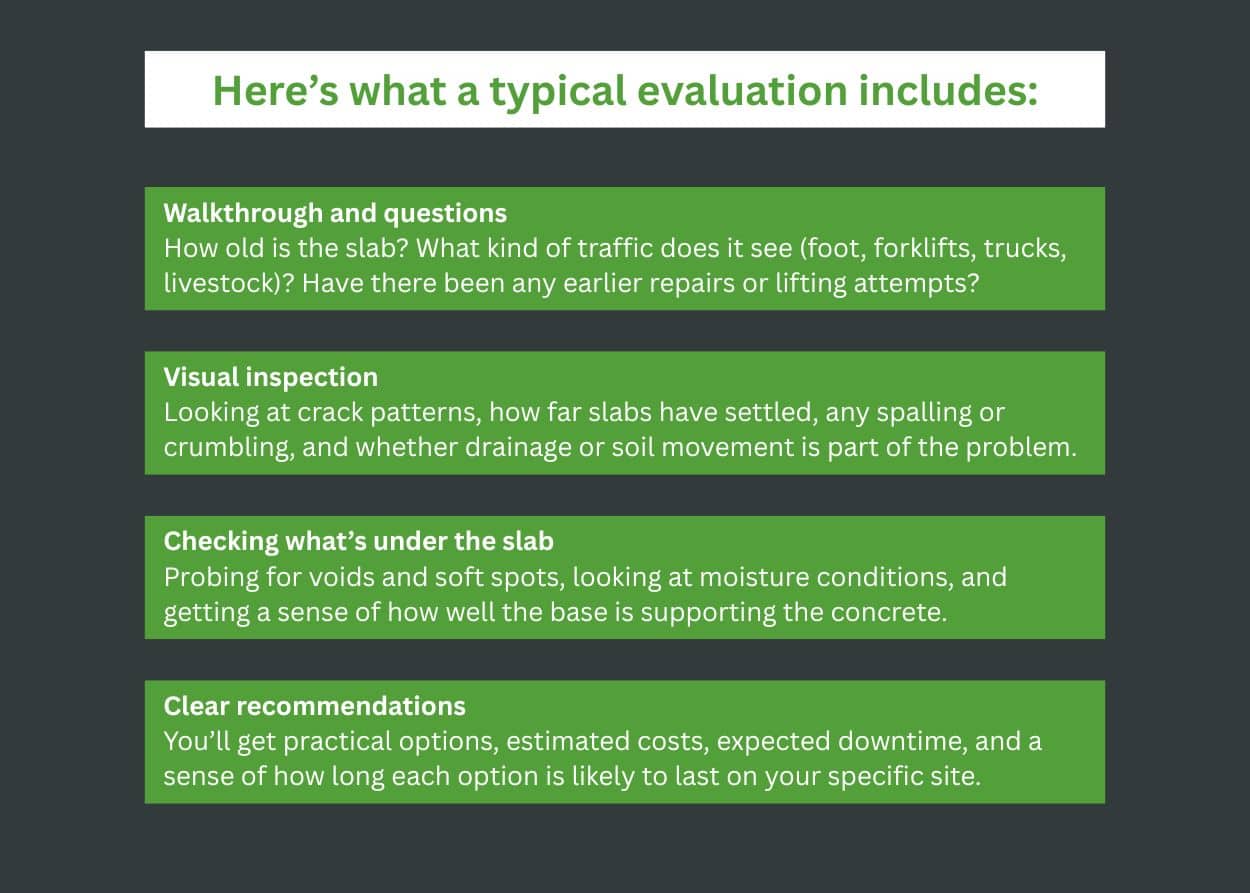
Here’s what a typical evaluation includes:
- Walkthrough and questions
How old is the slab? What kind of traffic does it see (foot, forklifts, trucks, livestock)? Have there been any earlier repairs or lifting attempts? - Visual inspection
Looking at crack patterns, how far slabs have settled, any spalling or crumbling, and whether drainage or soil movement is part of the problem. - Checking what’s under the slab
Probing for voids and soft spots, looking at moisture conditions, and getting a sense of how well the base is supporting the concrete. - Clear recommendations
You’ll get practical options, estimated costs, expected downtime, and a sense of how long each option is likely to last on your specific site.
If lifting and stabilization are a good fit, we’ll let you know.
If the concrete is too far gone and replacement is the honest answer, we’ll tell you that too.
And if someone has tried lifting before and it didn’t hold up? We actually like those projects. A fresh look—with the right materials and methods—can often give your slab a much better chance at a long, useful life.
A good partner doesn’t just sell the biggest job.
They recommend what they’d do if it were their own property.
Conclusion: Turning Concrete Problems into Concrete Solutions
Fast-forward one year.
Walkways are level and solid.
Trucks and forklifts roll smoothly instead of bouncing over settled joints.
Customers, employees, and livestock move through your space without trip hazards or washed-out sections.
You’re no longer wondering if the next freeze will push that slab over the edge.
You’re putting money into concrete that works for you, instead of wasting it on fixes that don’t last.
Keystone Gun-Krete is here to help you get there. We have decades of experience in concrete pumping and concrete lifting across south central Pennsylvania and beyond. Our team focuses on one thing: making concrete work smarter and last longer for farms, commercial sites, and industrial facilities.
Ready for a simple plan?
- Walk your property.
List cracks, settled areas, and drainage problems. Take photos. - Gather a few basics.
Note how old the slabs are, what kind of traffic they see, and any past repairs or lifting attempts. - Contact Keystone Gun-Krete.
We’ll look at your project, talk through your options, and give you honest guidance on where and when repair makes sense—and where replacement will better protect your budget and your people.
When you make the right call on concrete repair vs replacement, you end up with safe, reliable concrete that supports your work, day in and day out.
Want to dig deeper into concrete solutions for your property? Check out these related resources from Keystone Gun-Krete:
